Facebook
 X
X
 Pinterest
 Copy Link
The Massachusetts housing market continues to resist many of the broader national slowdown trends, particularly in Greater Boston and high-demand suburban communities. While elevated mortgage rates and affordability challenges continue to weigh on buyers, inventory constraints and steady demand are still supporting prices across much of the region.
What the Latest Data Shows
According to the Massachusetts Association of Realtors and Realtor.com data published in April and May 2026, housing inventory has improved modestly compared with the extreme shortages of 2021–2023, but supply remains well below pre-pandemic norms. Realtor.com reported approximately 14,198 active listings statewide in April 2026, with a median listing price of approximately $719,000. Massachusetts median sold prices remained elevated at roughly $610,000 statewide.
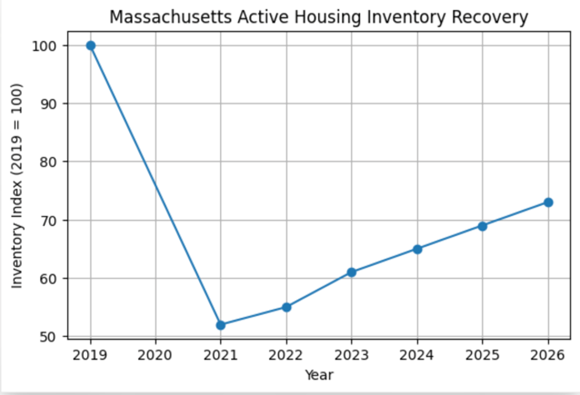
The Massachusetts housing market remains one of the more resilient markets in the country. Even with mortgage rates remaining above 6%, Greater Boston inventory constraints and continued demand are preventing the kind of correction some analysts predicted. New data from spring 2026 shows a market that is moderating — but not collapsing.
Mortgage Rates Remain a Major Constraint
Mortgage rates continue to shape buyer behavior. National 30-year fixed mortgage rates have generally ranged between 6.2% and 6.7% during spring 2026, according to Freddie Mac, Bankrate, and Reuters reporting. Rates dipped briefly earlier in the year but remain significantly higher than the sub-3% loans many current homeowners still hold. That ‘lock-in effect’ continues to suppress new listings because many homeowners are reluctant to trade low existing mortgage payments for substantially higher borrowing costs.
Massachusetts Continues to Diverge from Many U.S. Markets
Unlike some Sun Belt markets that experienced substantial inventory growth and price softening, eastern Massachusetts continues to face structural housing shortages driven by limited buildable land, restrictive zoning, and strong employment centers tied to higher education, biotechnology, medicine, and technology. Several Greater Boston analysts continue to describe the market as a ‘rebalancing’ rather than a true buyer’s market.
Luxury and Well-Located Homes Continue to Move
Industry reports throughout spring 2026 indicate that well-priced homes in desirable communities such as Newton, Brookline, Cambridge, Wellesley, and Weston continue to attract strong interest, especially turnkey properties. At the same time, overpriced listings are spending longer on market, giving buyers somewhat more negotiating leverage than during the height of the pandemic-era market.
What Buyers and Sellers Should Watch
For buyers, increased inventory and slightly longer market times may create more opportunities than existed over the past several years, particularly for homes needing updates or properties that have been on the market for multiple weeks. For sellers, pricing strategy and preparation remain critical. Homes that are appropriately priced and professionally marketed continue to perform best, while aspirational pricing is meeting more resistance than it did in 2021–2022.
Sources
- Massachusetts Association of Realtors (MAR), April and May 2026 market updates
- Reuters housing market coverage, May 2026
- Realtor.com Massachusetts Housing Market Trends, April 2026
- Axios Boston housing market reporting, April–May 2026
- Freddie Mac Primary Mortgage Market Survey, Spring 2026